
Pocket, Barn and Folding Doors
Pocket, Barn and Folding Doors, Made to Your Opening
Doors that slide into the wall, glide along it, or fold out of the way. Made to your opening in wood veneer, laminate, paint or any finish you need, and matched to the track or folding hardware you specify.
- Four ways to openPocket, barn, bypass or folding
- Made to your openingSizes from your drawings
- Matched to your hardwareCore and thickness to suit
- 12–14 weeksProduction start to delivery at your site
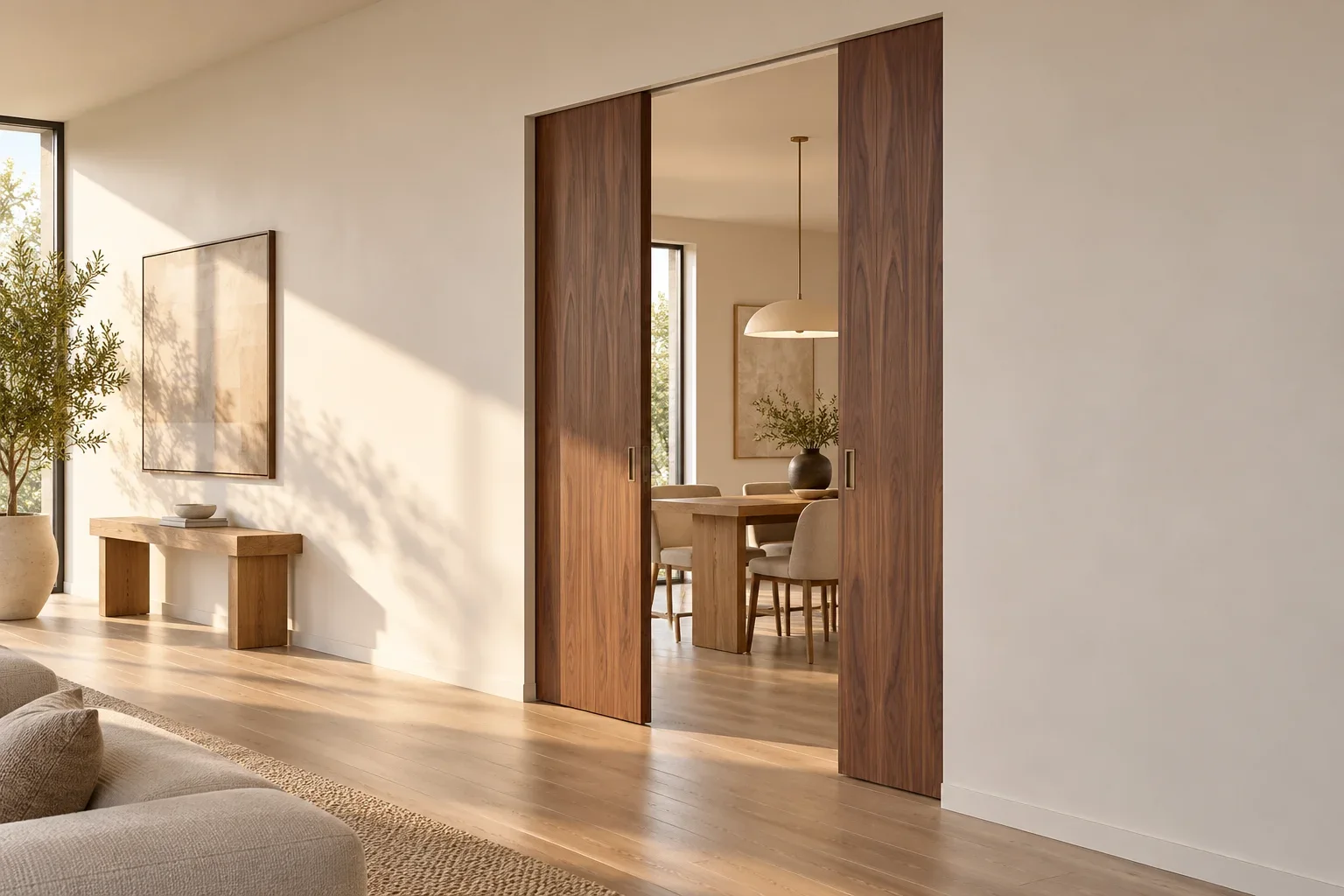
01 — Which one fits
Four Ways to Open Without a Swing
Where the door goes when it opens decides which one fits your room.
Pocket Doors
The door slides into a cavity inside the wall and disappears.
- No swing space needed
- Wall beside the opening stays clear
- Needs a pocket frame in the wall
- Best for tight rooms, baths and closets
Barn and Sliding Doors
The door hangs from a track on the wall face and parks beside the opening.
- No work inside the wall
- Track and door become a design feature
- Needs clear wall beside the opening
- Less privacy than a hinged door
Bypass Doors
Two or more panels slide past each other on parallel tracks.
- Stays in the plane of the opening
- Good for wide closets and laundry
- One side of the opening at a time
- Single or double track
Bi-Fold and Multi-Fold
Hinged panels fold to the side of the opening.
- Access to almost the full opening
- Folded stack sits in the room
- Multi-fold for wide openings
- Lighter panels for the hardware
02 — Popular styles
Popular Styles and Colors
Popular looks for sliding and folding doors in U.S. homes. Each one is made to your opening.
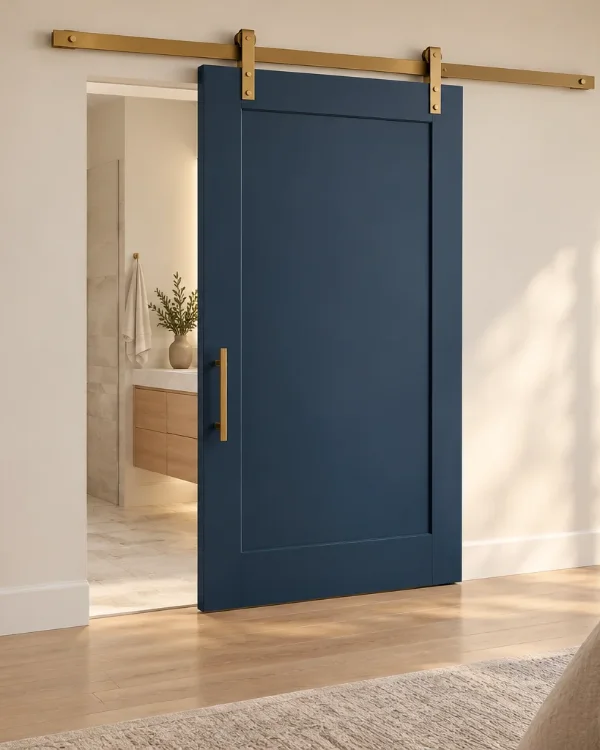
Shaker 1-panel
A clean frame around one tall recessed panel.Bedrooms, baths, offices
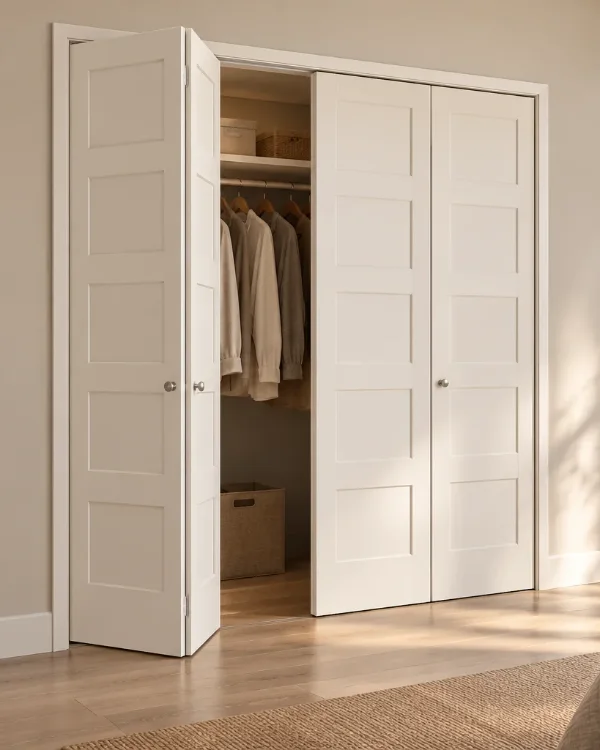
Shaker 5-panel
Five equal flat panels stacked between rails.Closets, pantries, hallways
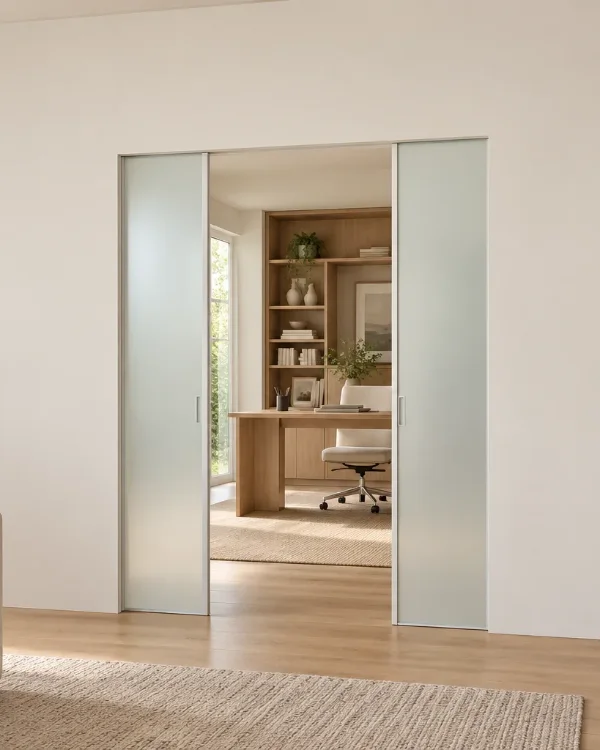
Frosted glass
One full-height frosted or reeded glass lite in a slim frame.Offices, pantries, baths
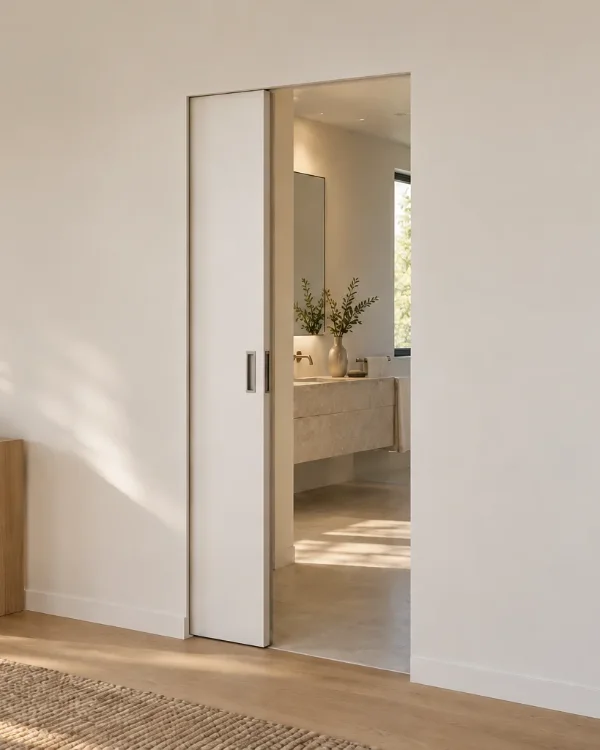
Flush
A plain flat face with a recessed edge pull.Baths, closets, modern homes
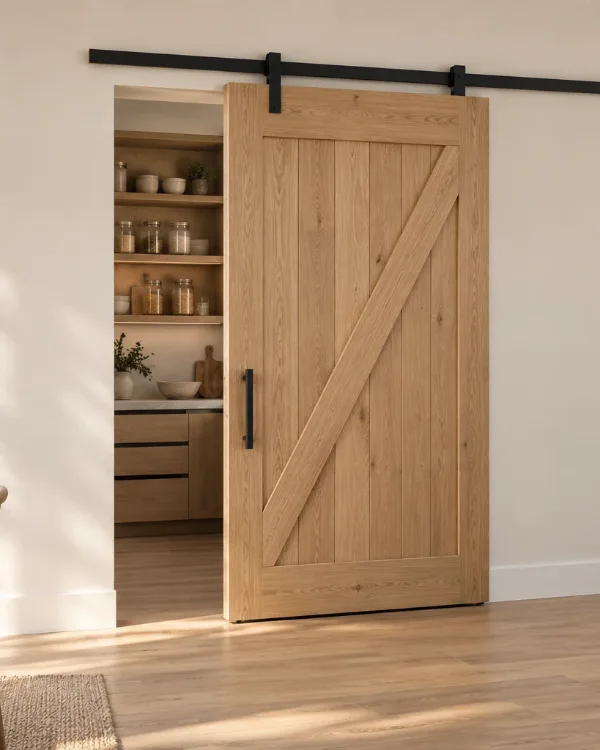
Z-brace plank
Vertical boards with top and bottom rails and a diagonal brace.Pantries, laundry rooms, dens
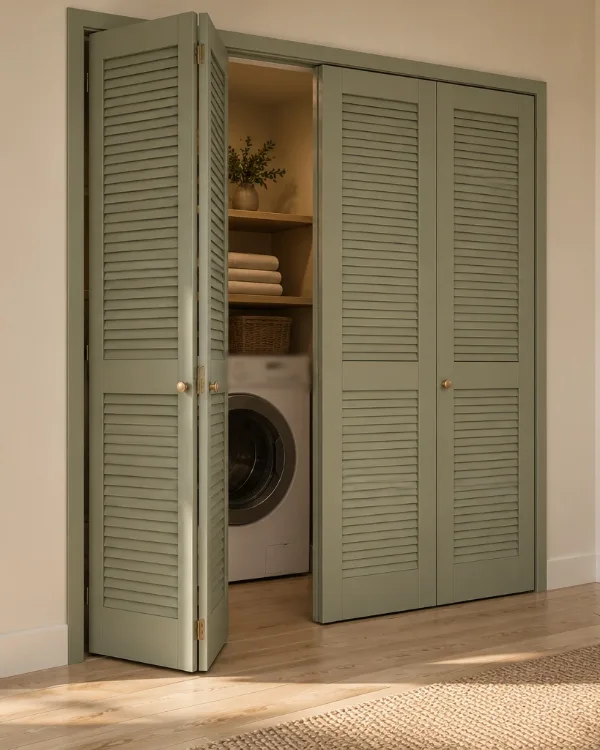
Louvered
Horizontal slats that let a closet or laundry breathe.Laundry, linen and utility closets
Most popular by door type
- Barn doorsZ-brace plank, British brace, Shaker panel, glass panel, X-brace
- Pocket doorsShaker 1-panel, frosted glass, flush, multi-lite glass, Shaker 5-panel
- Bi-fold doorsLouvered, Shaker panel, raised panel, flush, mirror or glass
Popular colors and finishes
- WhitePaint
- Warm whitePaint
- Matte blackPaint
- Natural white oakWood veneer
- WalnutWood veneer
Images show each style, not a specific product. Pick one as your reference, or send your own photo or sketch. Send the color, pattern or photo you want, and your quote confirms it before production.
03 — Pocket doors
What a Pocket Door Needs
A pocket door is a door slab plus a pocket frame built into the wall. Plan these before the wall is framed.
- Rough openingTypically twice the door width plus 1 in. wide, and the door height plus 4 1/2 in. high. Your frame kit sets the exact size.
- Header and trackThe header carries the track the door hangs from. In a load-bearing wall, your builder sizes the header.
- The pocketSplit studs form the cavity. No switches, outlets, plumbing or wall-hung items over the pocket.
- Wall thicknessFrames for 2×4 walls usually take doors up to 1 3/4 in. thick; thicker doors need a 2×6 wall.
- Guides and jambsFloor guides keep the door centered. Split jambs finish the opening and come off to service the door.
Soft-close and soft-open kits are available for many pocket frames; some need a minimum door width.
04 — Barn and sliding doors
What a Barn Door Needs
A barn door rides a track on the wall face. Measure the wall around the opening, not just the opening.
- Track lengthAbout twice the door width, so the door can clear the opening.
- OverlapThe door covers the opening by about 1 to 2 in. on each side; more for bathrooms.
- HeadroomAbout 3 to 10 in. above the opening for the track, depending on the hardware.
- Clear wall and stand-offClear wall beside the opening for the parked door, with enough stand-off to pass casing and baseboard.
- Floor gap and guideAbout 1/2 in. above the floor, with a guide to stop the door swinging out. Over carpet, use a wall-mounted guide.
- BackingSolid backing for the track, as the hardware instructions require.
05 — Folding and bypass doors
Bifold and Bypass Doors, Side by Side
Both stay inside the opening. The difference is how much of it you can use at once.
- Bi-foldTwo hinged panels fold to one side on a top track and pivots. Almost the whole opening is usable.
- Multi-foldThree or more panels fold into a stack at one or both ends, for wide openings and room dividers.
- Folded stackFolded panels project into the room; plan for the depth of the stack.
- Panel weightFolding hardware has the lowest weight limits of these types, so the panel construction is chosen to suit the set you specify.
Bypass panels slide past each other and stay in the plane of the opening, opening one side at a time. Bi-fold doors are typically about 1 in. narrower and 1 to 2 in. shorter than the frame, to leave room for the hardware.
06 — Made to your hardware
The Hardware Sets the Door
Every track and folding system has weight and thickness limits. Send the hardware you plan to use with your drawings.
- Weight sets the core
Solid or hollow core. Send the hardware’s weight rating, and your quote confirms the construction for each opening.
- Thickness fits the frame
Door thickness matched to the pocket frame, track or folding set you specify.
- Pre-boring for your hardware
Pulls, locks and hardware positions prepared for what you specify.
- Any finish you need
Wood veneer, laminate, paint or another finish.
- Pulls and locks
Pocket doors use flush pulls and an edge pull; barn doors need pulls that clear the wall, and a barn-door latch where privacy matters.
- Tall and wide openings
Doors taller or wider than standard, made to the sizes on your drawings.
Built in our factory
Options That Help a Door Last
What we can build into your doors, and why it matters. Every order is specified per project, and your quote confirms what’s included.
- No edge strip to peel
Many veneer doors are edged with a thin glued-on strip, and that strip is often the first thing to lift or chip. On our veneer doors, our factory’s China-patented panel-bending technology folds the veneered panel around the edge in one piece, so there’s no strip and no seam at the edge.
- Plywood frames and edges
When your order includes frames, jambs and casings, we can make them in plywood instead of MDF. Plywood holds hardware screws firmly and swells less than MDF when moisture gets in; MDF absorbs moisture, then swells and softens.
- UV-cured finish
A UV-cured coating is available for veneer and painted finishes. It hardens under UV light at the factory, so the door arrives finished, with no spraying or drying on your site.
07 — Questions
Pocket, Barn and Folding Door Questions
More on configurations and finishes: Custom Interior Doors.
Are pocket doors worth it?
Where swing space matters and the wall beside the opening is clear, yes: it frees the floor space a swinging door needs. The trade-offs are a wall that can’t hold switches, outlets or plumbing over the pocket, and harder repairs because the track sits inside the wall.
Can you add a pocket door to an existing wall?
Yes, if the wall beside the opening is long enough and has no wiring or plumbing in the pocket area. It means opening the wall on both sides, installing a header and the pocket frame, then closing and re-trimming the wall. In a load-bearing wall, your builder sizes the header.
Do barn doors give privacy?
Less than a hinged or pocket door. A barn door hangs off the wall, so it leaves gaps that let sound and light through. More overlap, a solid-core door and a barn-door latch all help.
How much clearance does a barn door need?
Typically 3 to 10 in. of headroom above the opening for the track, clear wall beside the opening about as wide as the door, enough stand-off to pass casing and baseboard, and about 1/2 in. above the floor. Your hardware’s instructions set the exact numbers.
Can a pocket or barn door have glass?
Yes. A frosted or reeded glass lite is one of the most popular sliding door styles. Send a reference of the look you want.
Can you make double pocket doors?
Yes. We make the pair of doors to the double pocket frame you specify. The same goes for bi-fold pairs and bypass sets.
What do you need to know about the hardware?
The track, pocket frame or folding set you plan to use, or its spec sheet, with your drawings. Its limits guide the door’s thickness and construction. For pocket doors, we can supply the door alone, the door with its track and hardware, or a complete pocket frame kit; your quote confirms which. For locks and pulls, hardware is your choice: what you specify, or pre-boring for hardware you source yourself.
What affects the cost of a pocket, barn or folding door?
Size and thickness, the finish, the core, and how many panels. Send your opening for a quote, or see price examples in the estimator.
What is the lead time?
Custom door orders typically take 12–14 weeks from the start of production to delivery at your site. Production starts once your final specification is signed and your 50% deposit has cleared.
Do you install?
We supply; your installer installs.
Start with the opening
Send Your Opening
Send what you have; we reply by email within 1–2 business days. Attach up to 5 files: PDF, photos, Excel or Word. Finish samples are available on request; you cover the shipping.
- Opening width and height
- Wall thickness (2×4 or 2×6)
- Door type and handing
- Track or folding hardware
- Finish and core
- Project city and state
Or email info@baraven.com · La Mirada, CA: visits by appointment